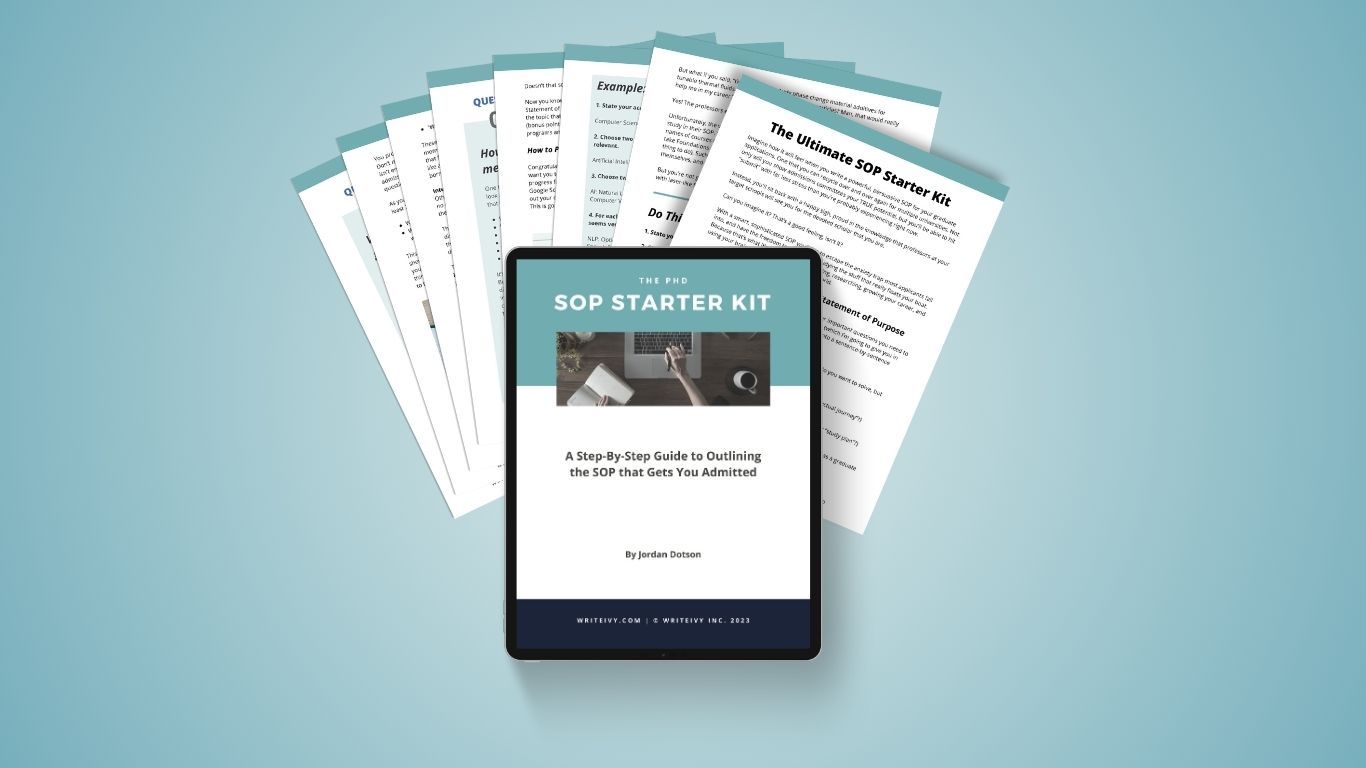
STOP THINKING LIKE A RESEARCH ASSISTANT
The PhD SOP Formula
A proven system for writing SOPs that convince faculty — before the interview — that you’re exactly the researcher they’ve been looking for.
YES, I'M READY – SHOW ME THE FORMULA →
THE ONE QUESTION NOBODY SEEMS TO ANSWER
“What are admissions committees really looking for?”
You searched. You read the articles. You looked at sample essays from students who got in. And somehow you’re more confused than when you started.
- You know your own research story. You just don’t know how to tell it in a way that proves you DESERVE to be admitted.
- Every SOP article you’ve found gives different advice, none of it feels quite right, and you’re starting to wonder if you’re missing something obvious.
- You still don’t understand “fit” – or why everyone keeps insisting it’s the most important thing.
- You drafted your SOP, then went online to compare it to “essays that worked!” – and now you’re realizing your essay will most certainly NOT work.
That’s exactly the problem this course was built to solve.


What you don’t yet know is how the best applicants tackle the SOP differently.
It may surprise you to learn that their strategy has little to do with better writing. (Frankly, some of them are terrible writers.) Instead, it has everything to do with better thinking.
They build logical, airtight cases for why admitting them is the right decision. They don’t just list their research experience and explain how they “grew interested in the field.” They write in a way that makes a search committee think: “This one fits with our research right now.”
PhD programs are the most competitive in all of academia, but the difference between candidates who get admitted and those who don’t rarely comes down to credentials. It comes down to the “fit” argument they make.
And luckily for you, that’s a learnable skill.
Hundreds of students have learned it in this course and walked away with multiple PhD admissions. Now it’s your turn.
INTRODUCING
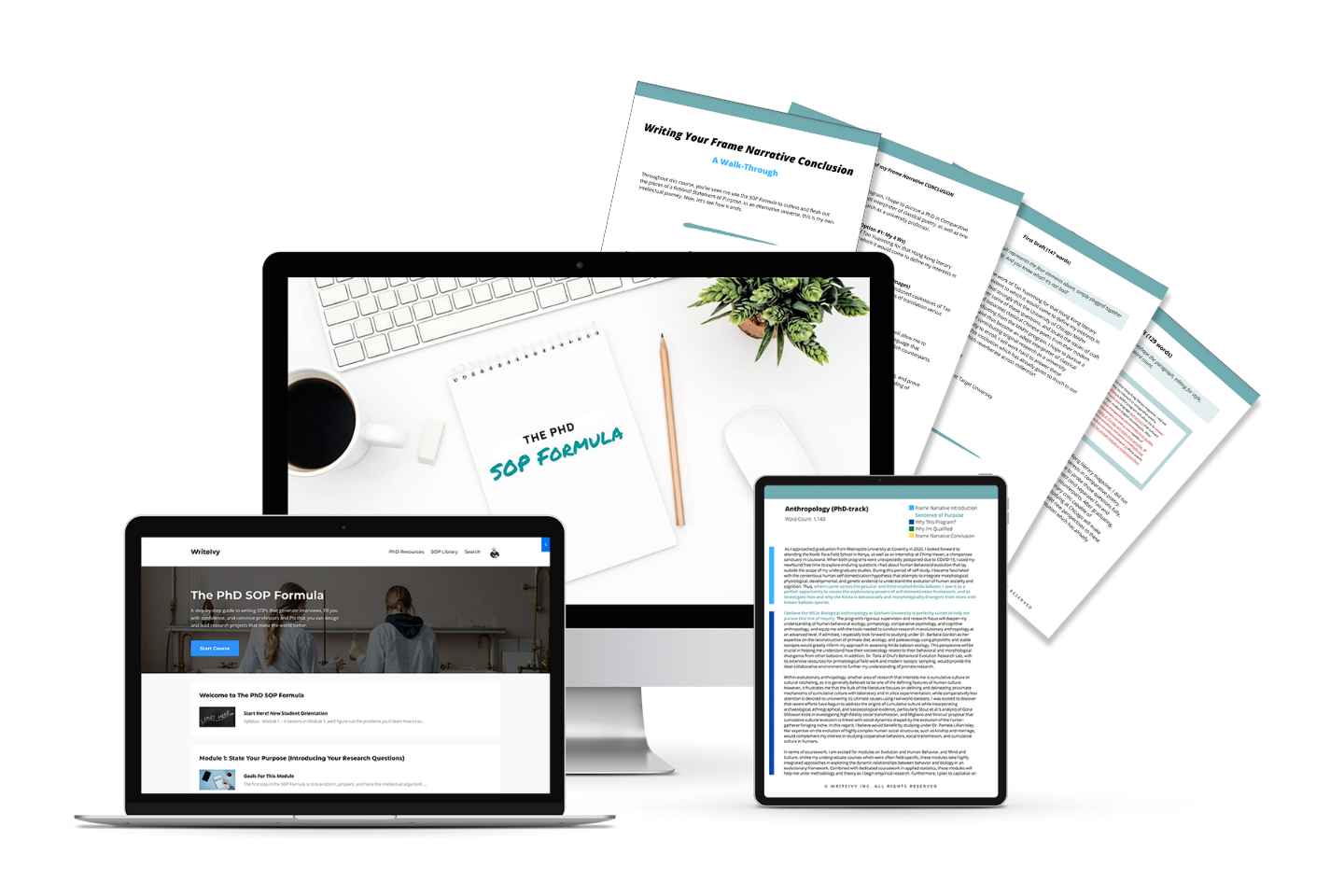
The PhD SOP Formula
A self-guided, step-by-step roadmap for writing SOPs that PhD faculty love to read.
The Formula is entirely text-based — structured lessons, guided writing exercises, and proven templates that you work through at your own pace to produce a complete, submission-ready SOP. No live sessions. No waiting. You start today, and most students finish in one to two weeks.
Make your admission the only logical outcome.
YES, I'M READY — SHOW ME THE FORMULA →"It helped me tremendously... it was just the right amount of support."

I applied to 12 schools and received interviews at 9 of them. I received acceptances from Emory, MIT, and Cornell this cycle and turned down remaining interviews.
I just want to thank you for your amazing course and the amount of effort you put into it because it helped me tremendously. The course had sufficient depth to help organize my thoughts and improve my writing skills. I found myself incorporating your tips beyond my SOP to apply to scientific writing in general, e.g. applying for conferences and helping my professor out with grants! I received encouraging feedback from postdocs reading my SOP and one of them assumed I paid for an editing service, which was really flattering, haha.
Ultimately, it was up to me to evaluate my own writing/thinking and your lessons were an extra push in the right direction. I think it was just the right amount of support provided, and having to think through the process on my own with your guidance facilitated my learning of fundamental writing techniques/habits and helped me regain confidence in my rusty writing skills. Thank you!
– Jena, Immunobiology
Inside the Formula
While everyone else is putting admissions committees to sleep with cookie-cutter autobiographical essays, you’ll be proving — with hard evidence and clear logic — that you have what it takes to design and lead research like a Principal Investigator in the making.
Here’s what’s inside the course…

MODULE 1
What Research Problems Do You Want to Solve?
Before you can write a great SOP, you need to know exactly what you’re arguing for—your ability to solve problems no one else has solved. In this module, you’ll get razor-sharp about your research agenda, and use that clarity to build the foundation your entire application rests on.
WHAT YOU’LL LEARN:
- Understand the psychological difference between applicants who seem like future PIs and tenure-track faculty, and those who…well…seem immature
- Craft research questions that signal intellectual authority (with a dose of humility), show you can think across the field, and align with what your target faculty are actively investigating right now
- Articulate the Broad Impacts of your work — how it will benefit society, advance the field, and make other scientists’ work possible
- NOW you can craft your “Sentence of Purpose” — the single most important line in your entire application
MODULE 2
Why Is This School the Perfect Place to Investigate These Problems?
The most important section of your entire SOP — and the one most applicants treat as an afterthought. In this module, you’ll build a “Why This Program” argument so specific and intellectually authoritative that faculty can see exactly how your research talents intersect with theirs.
WHAT YOU’LL LEARN:
- Target faculty advisors whose research questions overlap with yours in a way that creates unique synergy (and unique investigative opportunities)
- Identify program-specific resources — labs, archives, clinical access, coursework — that connect directly to the gaps in your own research preparation
- Avoid the most common “Why This School” mistake: writing like you’re submitting a research proposal, and not demonstrating the curiosity and self-awareness that faculty actually want to see
- Build a “Why This School” argument that’s specific enough to be convincing, flexible enough to show you’re ready to learn, and easy to adapt across every application in your list
MODULE 3
How Are You Qualified to Investigate Your Research Problems?
This isn’t an autobiography section, nor a CV, but a carefully constructed argument that proves, with specific evidence, that you’re the right person to investigate the research problems you and your target faculty both care about.
WHAT YOU’LL LEARN:
- Identify and rank your most meaningful research experiences — prioritizing those where you demonstrated autonomy
- Learn how to describe your past research the way scientists do: not just what you did, but what questions it raised, what you’d investigate next, and how it prepared you for the specific work ahead
- Learn how to incorporate professional skills, soft skills, and surprising personal experiences that signal you have what it takes to survive, happily, through five brutal years of doctoral research
- Close your argument by connecting your past experiences directly to your future, leaving the reader with one clear impression: "This person was built for this work."
MODULE 4
Why Do You Care About THESE Research Problems? What's Your Story?
Every PhD applicant has a story. Most tell the wrong one. This module shows you how to craft a story-driven opening that explains how you discovered your research problems, signals that you think the way faculty do, and makes the reader genuinely eager to learn more about you.
WHAT YOU’LL LEARN:
- Why the best introductions aren’t about youthful passions or motivation, but the moment you became someone who asks original research questions
- A set of brainstorming questions to identify your “Catalyst Moment” — the experiences that turned you from a student into a researcher with a specific intellectual mission
- How to make sure your story is so specific, no other applicant on the planet could have written it
- How to produce an opening that makes a faculty member stop, sit up, and think: “I need to meet this person”
MODULE 5
How Will You Conclude This Academic Journey?
A weak conclusion unravels the argument you’ve spent the entire essay building. This module shows you how to close the frame you opened in your intro — leaving the reader with a feeling of wholeness, inevitability, and confidence that admitting you is the right decision.
WHAT YOU’LL LEARN:
- The four elements of a powerful conclusion, and how to assemble them in a way that feels natural and confident to you
- How to write a Career Goals Statement that’s honest about where a PhD takes you: a faculty position, a role in industry, or a career at the intersection of both
- How the best conclusions make the entire essay feel like a single, unified argument for your admission
- Affirm with confidence that this program is your logical, inevitable next step — and leave the committee with no doubt that you’re exactly the kind of researcher they need
MODULE 6
Putting It All Together
You’ve done the thinking. You’ve done the writing. Now it’s time to make it shine. In this module, we take the building blocks from the previous five modules and assemble them into a single, seamless essay that flows as naturally as if it were written in one sitting.
WHAT YOU’LL LEARN:
- Use a beat-by-beat outline to make sure every section of your SOP keeps the reader engaged and interested
- Write elegant transitions so your essay reads as one fluid, logical argument rather than a series of blocks jammed together
- Cut your word count — without losing your argument — using techniques specifically designed for the brutal range of word limits you’ll encounter across applications (500 words? No problem.)
- Get genuinely useful feedback from your mentors and PIs using a structured cover sheet that ensures you never receive polite, useless non-answers
- Know exactly who NOT to ask for feedback, and why the wrong reviewer can do more harm than good
Plus, these bonuses to make sure your SOP is the best it can be…
BONUS 1
The WriteIvy Sample SOP Library
($200 VALUE)
See exactly how real students wrote their way into programs like Stanford, Harvard, Oxford, and more.
You’ll get access to 20+ sample essays — fully diagrammed and annotated to show you, step by step, how each one implemented the SOP Formula and how you can use the same approach. The library spans a wide range of academic fields, and many of these essays earned admission to five or more PhD programs.
BONUS 2
Common Problems & Troubleshooting Module
($150 VALUE)
None of us are perfect. Even if you’ve ruthlessly followed the SOP Formula, sometimes little problems pop up that you’re too close to see.
This bonus module walks you through the most common of those problems — oversharing, vague plans, and bad prose that signals poor thinking to admissions committees — and shows you exactly how to fix each one. Plus, you’ll receive a downloadable Troubleshooting Checklist to make sure nothing slips through before you hit submit.
BONUS 3
Expanded Guide: Personal Essays and Diversity Statements
($100 VALUE)
When programs ask for additional essays beyond the SOP, it can feel like the goalposts keep moving.
This guide gives you a clear framework for turning your life’s story into a mature, intellectual argument for why you’ll be an asset to any graduate community. It covers the three topics that most strong personal essays address in some form — Diversity, Adversity, and the Broad Social Impact of your research — and includes two fully diagrammed sample essays from students admitted to the #1 programs in their fields.
BONUS 4
Investigating Investigators: How to Find the Right Faculty Advisors
($100 VALUE)
Targeting the right faculty advisor is how you win before you even apply.
This guide shows you how the most successful PhD applicants choose where to send their applications — including how to use Google Scholar effectively, how to reach out to potential advisors before you apply, and how to conduct preliminary research so that by the time you’re on a Zoom call, you already seem like someone worth their time.
And one more thing…
Enrolled students also receive discounts for GradPilot, an excellent AI review system, to get instant feedback on their draft before submitting.
What WriteIvy Alumni Have to Say...

"I’m happy to say this year that out of my 7 applications, I received 5 interviews and 5 offers, including one to my top choice with full fellowship funding (which is INCREDIBLY selective even as far as PhD programs go)!!"
- Lia, Public Health
"I was very fortunate to receive both the NDSEG and NSF GRFP fellowships so it seems that your SOP strategies are also effective for those applications! Thank you again so much for your help. This application cycle was successful beyond my wildest expectations!"
- Rick, Electrical Engineering


“I applied to Stanford Biophysics, Harvard Biophysics, and Harvard-MIT Medical Engineering and Medical Physics PhD programs, and was admitted to all three. I will be attending Stanford funded by a Stanford graduate fellowship and an NIH fellowship.”
- Alice, Biophysics
"I felt confident in my statement and was able to get interviews at almost every program I applied to. You may hear this enough already, but I really appreciate the time and resources you provide to graduate school-hopefuls like me."
- Ben, Human Computer Interaction / Mech Engineering

When you enroll today, here’s what you get:
- All six modules of The PhD SOP Formula [$297 value]
- The WriteIvy Sample SOP Library [$200 value]
- Common Problems & Troubleshooting Module [$150 value]
- Expanded Guide to Personal/Diversity Essays [$100 value]
- Investigating Investigators: Finding the Right Faculty Advisors [$100 value]
That’s a total value of over $847 — yours for $297.

And that's not counting the value of the results you'll get if you follow this formula and put in the work...
The confidence of knowing you’ve written exactly what faculty want to read. The proof that you can design and lead research. And when the formula works the way it has for hundreds of students before you…the interview invitations that follow.
If this is what you’ve been looking for, choose your enrollment option below. Once your order is complete, you’ll receive immediate access to all course content and bonuses.
An application cycle of rejections costs you a year of your life. This course costs $297.
Choose the plan that’s right for you…
All sales are final. If you’re ready to do the work, let’s go.
After you enroll, you’ll have the option to add Admitted — our mini-course on research statements, scholarship essays, and every other supplemental essay — at a special one-time price. It’s the natural next step once your SOP is done.
WriteIvy students have been accepted into graduate programs at:



























HIGHLIGHTS INCLUDE…
One Mechanical Engineer admitted to 7 top-12 programs
Two students went from all rejections to 5 admits in a single year — without any new research experience
Multiple Biomedicine students rejected for three straight years — then admitted to as many as 4 programs after following the SOP Formula
One Robotics applicant with zero papers and no Master’s degree admitted to a co-advised PhD after two professors independently flagged his SOP as “special”
One Biophysics applicant admitted to Stanford, Harvard, and Harvard-MIT — all three, with two fellowships
One Clinical Psychology applicant rejected twice, then admitted to her #1 program on the third attempt
A Brazilian medical doctor with no programming background admitted to Georgia Tech’s Bioinformatics PhD
An Environmental Engineer who couldn’t get a letter from her supervisor admitted to Cornell and UT Austin (and more) anyway
Dozens of admits to Stanford, Harvard, MIT, and Oxford — across fields from Aerospace Engineering to Art History to Economics
Add yourself to the list of WriteIvy’s success stories.
Meet Your Instructor
Hi, I’m Jordan. I teach writing — specifically, the kind that gets people into fully-funded PhDs.
Since 2020, my guides have reached nearly 1 million applicants and I’ve read more statements of purpose than I can count. (Thousands. Literally.) What I’ve found is that the difference between an SOP that earns admission and one that doesn’t almost never comes down to credentials. It comes down to strategy — one that can be taught to anybody with a bachelor’s degree and a serious research agenda.
I’ve celebrated countless times with students who never imagined they could write an SOP that made them proud, let alone earn admission to the top PhD programs in the world.
So if you’re a PhD applicant of any kind, the only question worth asking is: why would you go through this process without a plan that’s already worked hundreds of times?

This course is for the applicant who’s tired of guessing.
Not the one who’s going to ask ChatGPT “how to write a statement of purpose” one more time.
Not the one who’s going to hand a messy draft to their labmates and hope that polite feedback somehow fixes it.
Instead, it’s for the applicant who’s looked at everything available — blog posts, Reddit threads, sample essays — and decided that there has to be a better way, a hidden curriculum that usually only reaches students lucky enough to have the right mentors and advisors in their corner.
The student who knows this application is too important to leave to chance.
If that’s you — if you’re ready to follow a proven process, do the thinking it requires, and produce an essay that proves you DESERVE to be admitted — then this course was built for you.
That said, let’s be honest about who it isn’t for.
This course is NOT for you if…
You just want someone to write it all for you.
Every word of this essay needs to be yours. The thinking process IS the essay. You can't outsource it and expect any faculty member to take you seriously.
You want a template you can fill in without thinking.
The Formula gives you structure and clear directions, but the ideas have to come from you. If you’re not willing to think hard about your research questions and your story, this won’t work.
Your deadline is in the next 48 hours.
Most students finish in one to two weeks. If you’re out of time, bookmark this for your next application cycle — and start earlier.
You’re not serious about a research career.
This course is built for people who want to spend the next five years designing and leading original research. If you’re still on the fence about whether a PhD is right for you, that’s a more important question to answer first.
"This course astounded me.
The lessons aren’t just instructions for writing an SOP — they made me rethink the entire application process. I don’t think there is anyone who shouldn’t read these lessons before they apply to grad school.”
– Wang Z., Economics

FAQs
Can I actually do this? I’m feeling overwhelmed by everything I need to write before my deadlines.
Can I try it before I buy?
Is this a live course, or can I go at my own pace?
Will I need to invest in anything else to write my SOP?
I haven’t written anything personal in years. Will this be too advanced for me?
When I enroll, do I get immediate access to everything?
What if I have questions while I’m working through the course?
How many sample SOPs are included?
Can I pay the first monthly installment and then cancel?
Will my SOP be reviewed when I finish?
Real Results. Real Students.
“There was one specific insight that completely changed my perspective: the idea that PIs are looking for future investigators, not research assistants.”
“Two professors independently noticed my SOP — without talking to each other. I had zero papers, no Master’s degree, and limited research experience.”
“After two failed attempts, I rewrote my SOP from the ground up. This time I didn’t just get accepted — I got into my #1 program with full funding and an additional scholarship.”
Your admission doesn’t have to be a gamble.
The only thing standing between you and the PhD program that will launch your career...is your argument. Let’s go write it.