STOP THINKING LIKE AN UNDERGRADUATE
The Master's SOP Formula
An A-Z blueprint for writing a brilliant statement of purpose that fills you with confidence, floods your inbox with admission offers, and launches your career as a graduate student.
SHOW ME THE FORMULA →
THE ONE QUESTION NOBODY SEEMS TO ANSWER.
“What do universities want me to write?”
You searched. You read the articles. You looked at sample essays from students who got in.
And somehow you’re more confused than when you started.
DOES ANY OF THIS SOUND FAMILIAR…?
- You drafted your SOP, then went online to compare it to “essays that worked!” - and now you’re realizing your essay will most certainly NOT work.
- Every article you’ve found gives different advice, none of it feels quite right, and you’re starting to wonder if you’re missing something obvious.
- The deadline is getting closer, and the longer you wait for clarity, the harder it gets to start.
- You know your own story. You just don’t know how to tell it in a way that proves you DESERVE to be admitted.
That’s exactly the problem this course was built to solve.


You already know the SOP is important.
What you don’t yet know is how the best applicants tackle it.
It may surprise you to learn that their strategy has little to do with better writing. (Frankly, some of them are terrible writers.) Instead, it has everything to do with better thinking.
They build logical, airtight cases for why admitting them is the right decision. They don’t just regurgitate CV material and explain how they “grew an interest in the field.” They write in a way that makes the committee think: “This one GETS IT.”
On average, you’re competing with dozens of qualified applicants for every single available spot.
The difference between those who get in and those who don’t almost never comes down to credentials. It comes down to the argument they make.
And luckily for you, that’s a learnable skill.
Hundreds of students have learned it in this course and walked away with multiple master’s admissions. Now it’s your turn.
INTRODUCING
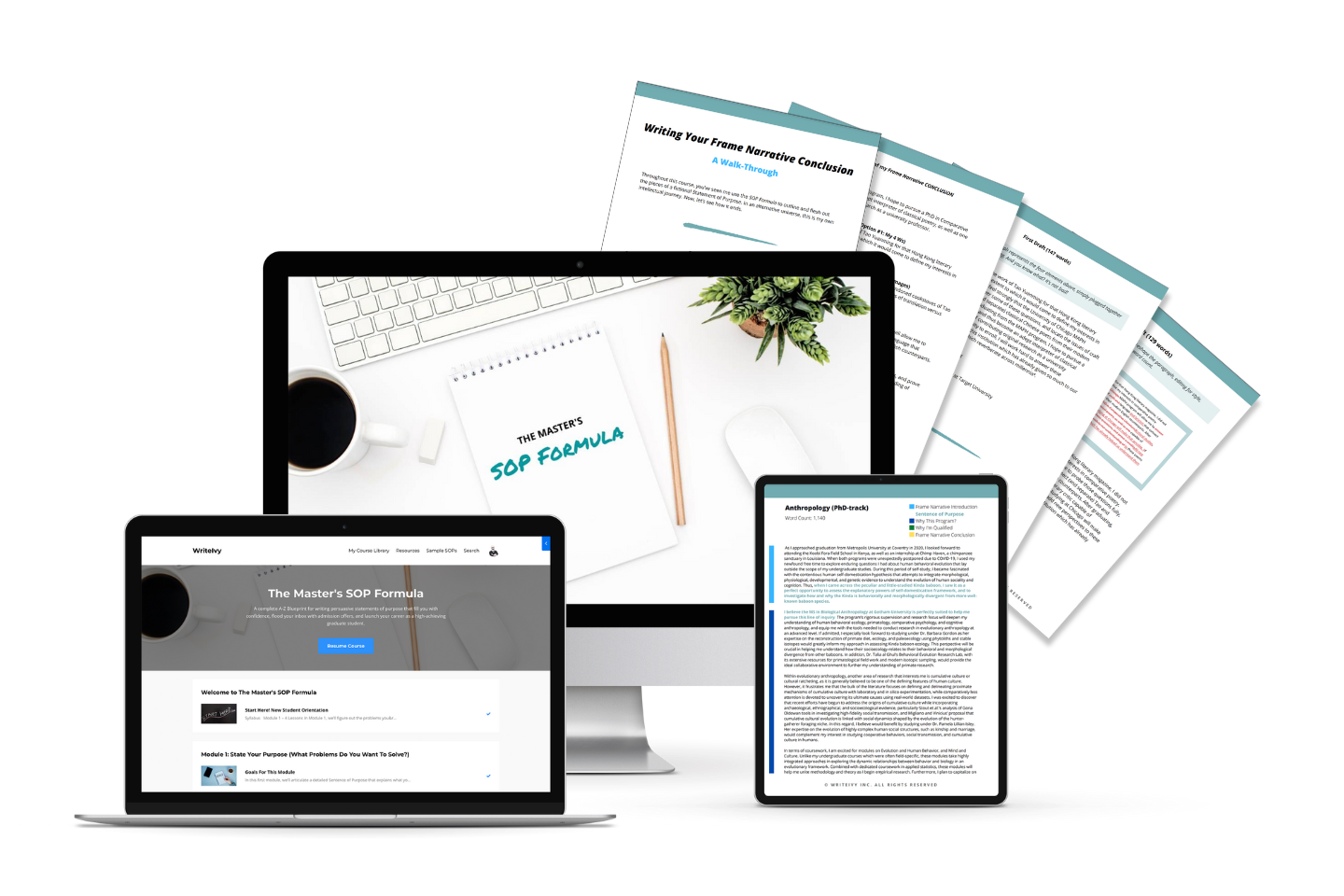
The Master’s SOP Formula
A self-guided, step-by-step roadmap for writing SOPs that grad schools love to read.
Make your admission the only logical outcome.
YES, I'M READY – SHOW ME THE FORMULA →
"Overall, I got accepted to 6 schools with 2 waitlists and ZERO rejections! Given my GPA of 3.29/4.0, and lack of academic publications or strong credentials, I think it's pretty safe to say that my essays were OBJECTIVELY stellar."
- Lee, Electrical Engineering
Inside the Formula
While everyone else is putting admissions officers to sleep with “autobiography” essays, you’ll be proving – with impeccable logic – that you have the drive and intelligence to succeed in your own unique career.
Think of it as having a friendly professor walk you through each step of an experiment: making sure you have exactly the right ingredients, in exactly the right order, so the result is never in doubt.
Here's what we'll tackle together...

MODULE 1
What Problems Do You Want to Solve in Your Career?
Before you can write a great SOP, you need to know exactly what you’re arguing for – and most applicants never get this clear. In this module, you’ll define your career goals with a precision most applicants never achieve, and use that clarity to build the foundation your entire SOP rests on.
WHAT YOU’LL LEARN:
- Identify the specific problem you want to spend your career solving – the thing people will actually pay you to do
- Use real job postings to reverse-engineer the skills and competencies your dream career requires
- Identify the gaps between where you are now and where you need to be – and turn those gaps into your SOP’s argument
- NOW you can craft your “Sentence of Purpose” – the single most important line in your entire application
MODULE 2
Why Is This School the Perfect Place to Prepare for Your Career?
The most important section of your SOP – one most students treat like an afterthought (if they even write it at all). In this module, you’ll build a Study Plan that shows the admissions committee exactly how their program will get you where you’re going. Not just why it’s your dream program, but why it’s the only logical stop between where you are now and the career you’re building toward.
WHAT YOU’LL LEARN:
- Match the skills you need to acquire with specific opportunities inside your target program – courses, faculty, research assistantships, internships, capstones
- Build an argument so specific that the committee can see exactly what your time in the program will look like (and know exactly where you’ll end up afterward)
- Understand why this section separates the admitted from the rejected – even for applicants with low GPAs or those who are totally changing fields
MODULE 3
How Are You Qualified to Pursue This Career?
Most applicants write this section as an autobiography: a chronological tour of everything they’ve ever studied or done. It reads like a CV in prose form, and it puts admissions committees to sleep. In this module, you’ll take that raw material and turn it into a focused, forward-looking argument that proves you’re ready for the specific demands of your target program.
WHAT YOU’LL LEARN:
- Build your “Greatest Hits List”: the academic and professional achievements that matter most for your target program, ranked in order of importance
- Reframe each item as evidence of readiness rather than a record of the past – every line pulls toward your Study Plan, not away from it
- Signal competence for the specific skills your program demands – not just what you did, but why it proves you’re ready to be an A+ grad student
- Rank your Greatest Hits by importance so you always know exactly what to cut when a brutal word limit demands it
MODULE 4
Why Do You Care About These Career Goals? What's Your Story?
This is what WriteIvy is most known for, and for most applicants, the hardest part of the essay to get right. Now that the logic of your SOP is in place, we go back to the beginning and write a story-driven introduction that captures reader attention, signals intellectual authority, and explains exactly how you came to care about the specific problem you’re going to grad school to solve. This, in other words, is where the magic happens.
WHAT YOU’LL LEARN:
- Use a sentence-by-sentence template to write a compelling narrative opening, even if you’ve never thought of yourself as a storyteller
- Signal intellectual authority from the very first sentence by grounding your story in the right kind of academic or professional achievement
- Explain how you encountered the problem you identified in Module 1 – in a way that feels urgent and completely unique to you
- Avoid the most common intro mistakes that make otherwise strong SOPs seem gimmicky, melodramatic, or painfully generic
MODULE 5
How Will You Conclude This Academic Journey?
A great SOP doesn’t just end…it resolves. In this module, you’ll write a conclusion that closes the narrative arc you opened in Module 4, leaving your reader with a sense of wholeness and completion. It’ll make your essay feel like a fully-formed argument (rather than a collection of well-written paragraphs), and make you look like a really talented writer and thinker.
WHAT YOU’LL LEARN:
- Close the frame: return to the story from your introduction and bring it to a satisfying (intellectual) resolution
- Write a punchy Career Goals Statement that states exactly where you’re headed after graduation, and names specific companies and organizations already working on the problems you care about
- Reiterate your Sentence of Purpose to make sure the reader leaves with your core argument firmly fixed in their mind
- Affirm with confidence that this program is your logical, inevitable next step…and leave the committee with no doubt that you’re exactly the kind of student they’re looking for
MODULE 6
Putting It All Together
You’ve done the thinking. You’ve done the writing. Now it’s time to make it shine. In this module, we take all the building blocks from the previous five modules and assemble them into a single, seamless essay that flows as naturally as if it were written in one sitting – not pieced together from five separate exercises.
WHAT YOU’LL LEARN:
- Use a beat-by-beat outline to make sure every section of your SOP lands exactly where it needs to
- How to write smart inter-section transitions so your essay reads as one fluid, logical argument rather than a series of (beautifully written) blocks jammed together
- Cut your word count without losing your argument using techniques specifically designed for the brutal range of word limits you’ll encounter across applications
- Get genuinely useful feedback from your professors, advisors, and PIs using a structured cover sheet that tells your reviewers exactly what to look for (and ensures you never again receive polite, useless non-answers)
- Know exactly who NOT to ask for feedback, and why the wrong reviewer can do more harm than good
Bonuses
And that's just the course.
Here's what else you'll get…
The WriteIvy Sample SOP Library
See exactly how real students wrote their way into schools like Stanford, Harvard, Oxford, and more. 33 fully annotated sample essays — diagrammed step by step to show you exactly how each one implements the SOP Formula. Every essay earned admission to multiple competitive programs. One student earned 13 offers.
Expanded Guide: Personal Essays and Diversity Statements
When schools ask you to write additional essays, it can feel overwhelming. This guide gives you the same clarity and structure for personal essays that the Formula gives you for your SOP — with detailed breakdowns and annotated samples from students admitted to the top-ranked programs in their fields.
Meeting Word Limits: SOP Formula Complete Walkthrough
Sometimes the hardest part isn't the first draft — it's carving it down to brutal word-limit requirements. Follow along as Jordan works through every exercise in the Formula, editing a 970-word SOP down to 770, then to 462. No matter how tight your word limit, we'll help you get there.
Common Problems and Troubleshooting
Even if you've followed the SOP Formula perfectly, sometimes little problems pop up that you're too close to see. This module walks you through the most common issues — oversharing, vague plans, and bad prose — and shows you exactly how to fix each one. Includes a downloadable Troubleshooting Checklist.
Enrolled students also receive discounts for GradPilot, an excellent AI review system, to get instant feedback on their draft before submitting.
Student results
The formula works.
Here's the proof.
This course broke it down into easy-to-understand pieces that made the process much less overwhelming. It also helped me clarify what I planned to use my degree for after graduation.
Skylar V.
Environmental Management
Accepted to
- Duke Nicholas School of the Environment MEM
- CU Boulder Master of the Environment
- Yale School of the Environment Waitlisted
Before your framework, I had a dozen SOP drafts that were chaotically organized. Finding your resources was like a holy grail — the frameworks forced me to dig deeper into my own academic motives and set clear goals for myself.
Rachel F.
Human Computer Interaction — 3 of the top 5 programs in her field
Accepted to
- University of Washington HCI
- UC Berkeley Partial scholarship
- University of Michigan 50% scholarship
When you enroll today, here’s everything you get:
- All six modules of The Master’s SOP Formula [$497 value]
- The WriteIvy Sample SOP Library [$200 value]
- Expanded Guide to Personal and Diversity Essays [$100 value]
- Meeting Word Limits: SOP Formula Complete Walkthrough [$100 value]
- Common Problems and Troubleshooting [$150 value]
Total value: $1,047 – yours today for just $247
After you enroll, you’ll have the option to add Admitted – our supplemental essay course – at a special one-time price. It’s the natural next step once your SOP is done.

Choose the plan that’s right for you…
Your SOP is waiting. Let’s get to work.
WriteIvy students have been accepted into graduate programs at:




























Admitted to 12 out of 14 programs — including CMU, Georgia Tech, Michigan, UCLA, UT Austin, Purdue, Columbia, USC, and UCSD. WriteIvy gave me the confidence to write my own essay with certainty, following a thoroughly researched, proven formula that has worked hundreds of times.
Roy T.
Electrical & Computer Engineering
Tying together the WHY in my SOP early, and incorporating how I planned to extend my experiences at each program, led me to feel confident in my essay and frame my story coherently for admissions officers. I was admitted to Cornell Tech's MEng in Data Science, Columbia's MS in Data Science, and Harvard Medical School's Master of Medical Sciences in Biomedical Informatics.
Taylor V.
Data Science & Biomedical Informatics
HIGHLIGHTS INCLUDE…
Multiple MSCS admits at Carnegie Mellon and Stanford – with full funding through assistantships
One student earned 13 MPH admissions, including multiple Top 5 programs
One married couple was admitted to 9 of the same MSIM programs
Dozens of students with sub-3.0 GPAs admitted to multiple competitive schools
Add yourself to the list of WriteIvy’s success stories..
Meet Your Instructor
Hi, I’m Jordan. I teach writing – specifically, the kind that gets people into grad school.
Since 2020, my guides have reached nearly 1 million applicants and I’ve read more statements of purpose than I can count. (Thousands. Literally.) What I’ve found is that the difference between an SOP that earns admission and one that doesn’t almost never comes down to credentials. It comes down to strategy – one that can be taught to anybody with a bachelor’s degree.
I’ve celebrated countless times with students who never imagined they could write an SOP that made them proud, let alone earn admission to the top graduate programs in the world.
So if you’re a master’s applicant of any kind, the only question worth asking is: why would you go through this process without a plan that’s already worked thousands of times?

This course is for the applicant who’s tired of guessing.
Not the one who's going to ask ChatGPT "how to write a statement of purpose" one more time. Not the one who's going to ask their roommate to proofread another messy draft, hoping for some magical approval they know they haven't earned.
Instead, this course is for the applicant who's looked at everything available — blog posts, Reddit threads, sample essays — and decided that what's out there isn't good enough. The applicant who knows there’s a better way, a hidden curriculum that usually only reaches students lucky enough to have the right mentors in their corner.
The student who knows this application is too important to leave to chance.
If that's you — if you're ready to follow a proven process, do the thinking it requires, and produce an essay that proves you deserve to be admitted — then this course was built for you.
This course is NOT for you if…
You just want someone to write it for you.
Every word of this essay needs to be yours. The thinking process IS the essay. You can't outsource it and expect anyone to take you seriously.
You want a template to fill in without thinking.
The Formula gives you structure and clear directions, but the ideas have to come from you. If you're not willing to think hard, this won't work.
Your deadline is in the next 48 hours.
Most students finish in one to two weeks. If you're out of time, bookmark this for your next application cycle — and start earlier.
You haven't decided what you want to study.
The Formula will help you articulate your goals with precision, but it can't create goals you don't yet possess. Come back when you're ready.
"This course astounded me.
The lessons aren’t just instructions for writing an SOP, but totally made me rethink the whole application process. Let me just say this: I don’t think there is ANYONE who shouldn’t read these lessons before they apply to grad school, regardless of the programs they apply to."
– Wang Z., Economics

FAQs
Questions your fellow grad applicants asked before they enrolled in The Master's SOP Formula
Can I try it before I buy?
Is this a live course, or can I go at my own pace?
I'm feeling overwhelmed by all the things I'll need to write before my deadlines. Are you sure I can do this?
Will I need to invest in anything else to write my SOP?
I haven’t written anything in SO LONG. Will this be too advanced for me?
When I join The Master’s SOP Formula, will I be getting immediate access to all the lessons and modules?
What if I have questions while I’m working through the course?
How many sample SOPs will I get to see?
Can I pay the first monthly installment and then cancel my enrollment?
Are there live classes?
Will Jordan review my SOP when it’s finished?
Your admission doesn’t have to be a gamble.
The only thing standing between you and your dream program is your argument. Let’s go write it.